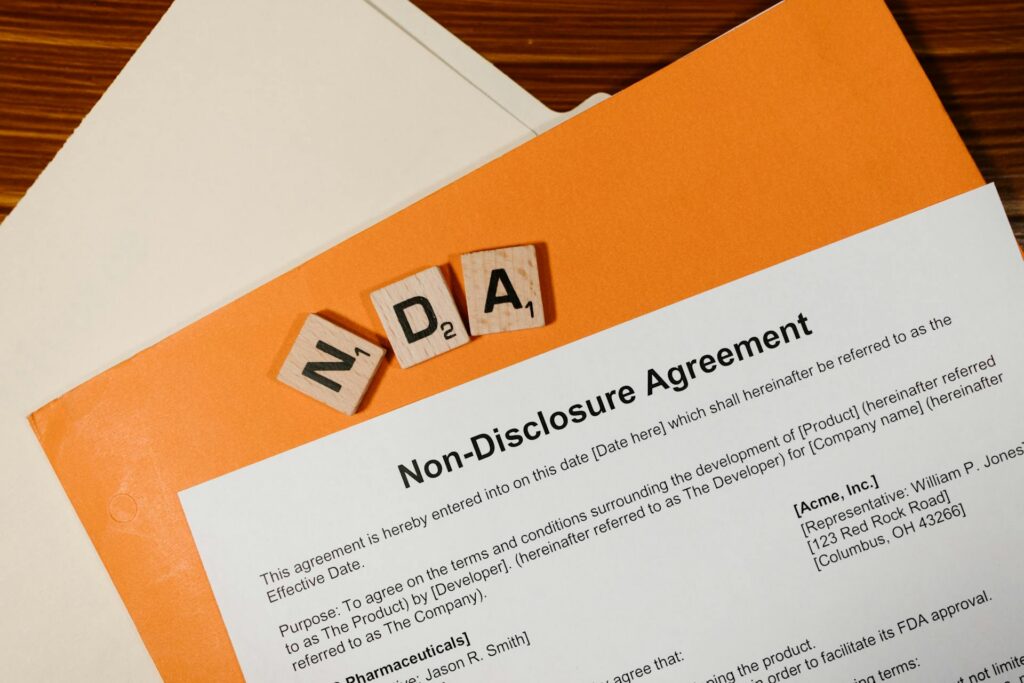
Confidentiality is an integral part of doing business. Companies, both small and large, have information or processes they believe give them an edge in the Darwinian world of economics, and any release of that data can undermine their ability to survive or thrive.
This is the underlying idea behind Intellectual Property law, which helps enforce the individual or business entity’s ability to retain control over the essential information they’ve created. The need for secrecy and information protection complicates matters when those entities must provide essential information to outsiders, whether new employees or contractors, who use it to conduct operations in the entity’s name.
This is where the Non-Disclosure Agreement, or NDA, comes into play. NDAs should (in theory) specify exactly what is proprietary information, who can or cannot share it, and when. Unfortunately, many businesses either do not recognize the importance of drafting an NDA before any discussion of a deal takes place or use simplified templates with language that is too broad to enforce effectively.
Why NDAs Matter Before Information Leaves the Building
Beyond specifying the use of proprietary information, NDAs serve a broader function than many business owners realize. The greatest threat to confidential and sensitive information often comes from internal sources, including employees, which means NDAs are not only about external negotiations but also about establishing internal safeguards through legally-enforced deterrence.
More than a third of Americans are currently bound by NDAs, which helps normalize their use across ordinary business relationships rather than only high-profile corporate transactions. Unfortunately, laws regarding NDAs can vary wildly from state to state, so business owners looking to use them need to be well-informed about the local rules and regulations governing their use.
California law provides a specific framework for this issue through the California Uniform Trade Secrets Act. Under Civil Code section 3426.1, a trade secret includes a formula, pattern, method, process, or technique that derives economic value from not being generally known and is subject to reasonable efforts to maintain secrecy.
That definition matters because it sets a real threshold for what the law may protect. An NDA can help preserve confidentiality, but it is strongest when the business is also behaving as though the information is genuinely worth protecting.
Choosing Between Unilateral, Mutual, and Multilateral NDAs
Not every NDA serves the same function. There are three primary types of NDAs, each intended to provide protection based on how information is shared between parties.
A unilateral NDA is the common one-way format in which one party discloses confidential information, and the other agrees to keep it secret. This is often the right fit when only one party is required to disclose critical information, as in the case of a seller who discloses financials early in acquisition talks or a company that hires a contractor to work with sensitive internal systems.
A mutual NDA, on the other hand, is used when two parties must share essential information with one another to conduct their business. Mutual NDAs are commonly used during negotiations for mergers, joint ventures, strategic partnerships, or similar business relationships where each side needs protection during evaluation and negotiation.
A multilateral NDA is used when a business deal involves three or more entities, with at least one party disclosing sensitive information. These agreements are less common, but they can simplify a complicated transaction by covering all parties under a single framework rather than requiring separate unilateral or bilateral agreements.
What Makes an NDA Enforceable in California
NDAs are a powerful tool for protecting proprietary information, but their effectiveness depends heavily on their specificity. When determining whether an NDA is enforceable, courts assess whether the agreement is drafted with sufficient clarity to define what is protected, and overly broad agreements tend to be discounted during proceedings.
One of the most important issues is the definition of confidential information. Many businesses fall into the trap of using broad language that says, in effect, “all confidential information and trade secrets are protected,” without clearly identifying what that means in practice.
That kind of catch-all language creates risk because courts are less likely to enforce a vague secrecy obligation that leaves the receiving party guessing. A stronger NDA identifies categories of information with enough precision that both sides can understand what is covered.
Specifying the duration of the agreement is another integral aspect of a well-crafted NDA. For general confidential business information, a fixed term of one to five years is often typical, while information that truly qualifies as a trade secret may justify protection for as long as it remains secret.
That distinction is important because California courts have pushed back on NDAs that expire arbitrarily when trade secrets are involved. If the information still has economic value because it is not publicly known, a fixed expiration period may undermine the very protection the agreement was supposed to provide.
Most enforceable NDAs also include standard carve-outs. Information is usually excluded from protection if it has already been made public, has been independently developed, or the receiving party already has access to it, for example.
In a similar vein, situations may arise in which disclosure is legally required. A court order or government mandate can override the confidentiality obligation, and information that can be lawfully reverse-engineered or independently discovered may not remain protected in the same way as information that is truly secret.
What Happens When an NDA Is Breached
A properly drafted NDA provides specific avenues for recourse when the agreement is breached. This provides enforcement mechanisms that allow companies to potentially recover their losses and serves as a deterrent to parties with limited means from engaging in information trading altogether.
CUTSA provides a structured set of remedies in trade secret cases. Courts may issue injunctive relief to prohibit further use or disclosure, award damages for actual losses and unjust enrichment, and impose exemplary damages up to twice actual damages in cases of willful and malicious misappropriation.
A significant recent development came in Applied Medical Distribution Corp. v. Jarrells in 2024. The California Court of Appeals held that monetary damages are not a required element of a trade secret misappropriation claim. This means that a company may still pursue injunctive relief and legal fees even if it cannot prove a specific dollar amount of harm.
Federal enforcement of NDAs can also come into play under the Defend Trade Secrets Act. Under the DTSA, federal courts can adjudicate trade secret claims and, in extraordinary circumstances, may allow ex parte seizure to prevent the further spread of the information before a case is fully litigated.
In some cases, the harm caused by an NDA breach is too big to be fully undone. When that happens, courts may require the defendant to pay a royalty for continued use of the trade secret rather than pretending the information can simply be made secret again.
How Villasenor Law Offices Helps Businesses Protect Confidential Information
For businesses, NDA problems are usually easier to prevent than to fix. Rather than turning to an online template that can’t be properly specified for your business’s needs, it’s best to work with a business attorney from the beginning to ensure the draft is strictly enforceable.
Villasenor Law Offices helps businesses with NDA drafting and review by focusing on enforceability and the specific risks present in the relationship at issue. Villasenor’s team of experienced legal experts works with companies to identify exactly which information qualifies for protection and how the agreement should be structured for the specific relationship.
Our attorneys will also take enforcement action if your NDA is breached, regardless of whether Villasenor drafted the document. If litigation becomes necessary, we will take all steps necessary to defend the NDA’s stipulations in court, up to and including seeking relief before federal judges.
If your business is thinking about sharing sensitive information with an outside party or even an internal employee, give Villasenor Law Offices a call. Our legal team will provide you with a tailor-made NDA specified for the exact nature of the relationship and will help enforce it if the time comes.
FAQ’s
Why should a business use an NDA before discussing a deal?
An NDA helps protect confidential information before it leaves the business. The article explains that companies often need to share sensitive financial, operational, or proprietary information with employees, contractors, or potential deal partners, and a properly drafted NDA helps define what is protected, who may share it, and when disclosure is prohibited.
What makes an NDA enforceable in California?
A strong NDA must be specific enough to clearly identify what information is protected. The article notes that overly broad confidentiality language can weaken enforceability, while a better agreement defines protected information with precision, addresses duration appropriately, and includes standard carve-outs for information that is public, independently developed, already known, or legally required to be disclosed.
What can happen if someone breaches an NDA?
If an NDA is breached, a business may be able to seek injunctive relief, damages for actual losses and unjust enrichment, and in some trade secret cases exemplary damages. The article also explains that businesses may still pursue injunctive relief and legal fees even when a specific dollar amount of harm is difficult to prove.
Disclaimer: The content of this website or any blog is for information or educational purposes only. Nothing on this website or blog should be considered legal advice for any individual case or matter. This information is not intended to create, and receipt or viewing does not constitute an attorney-client relationship.